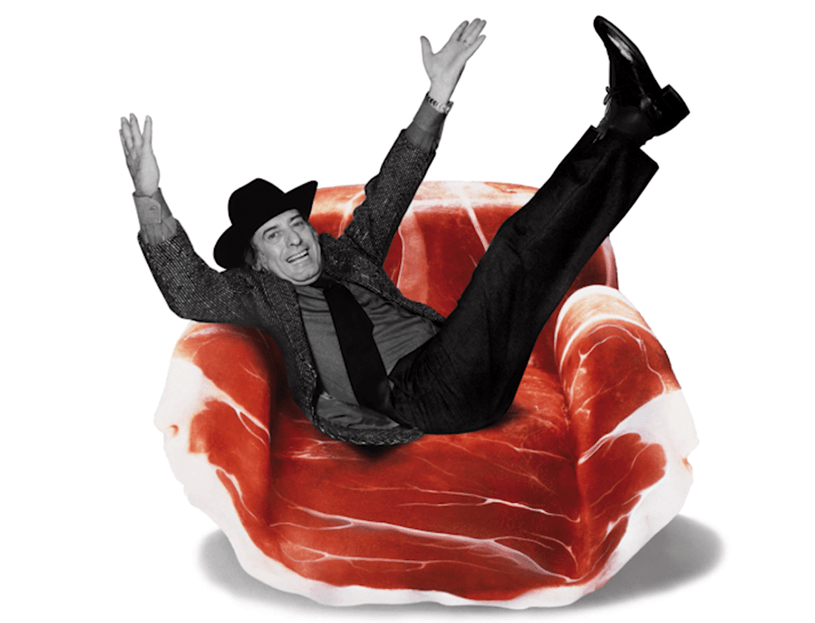
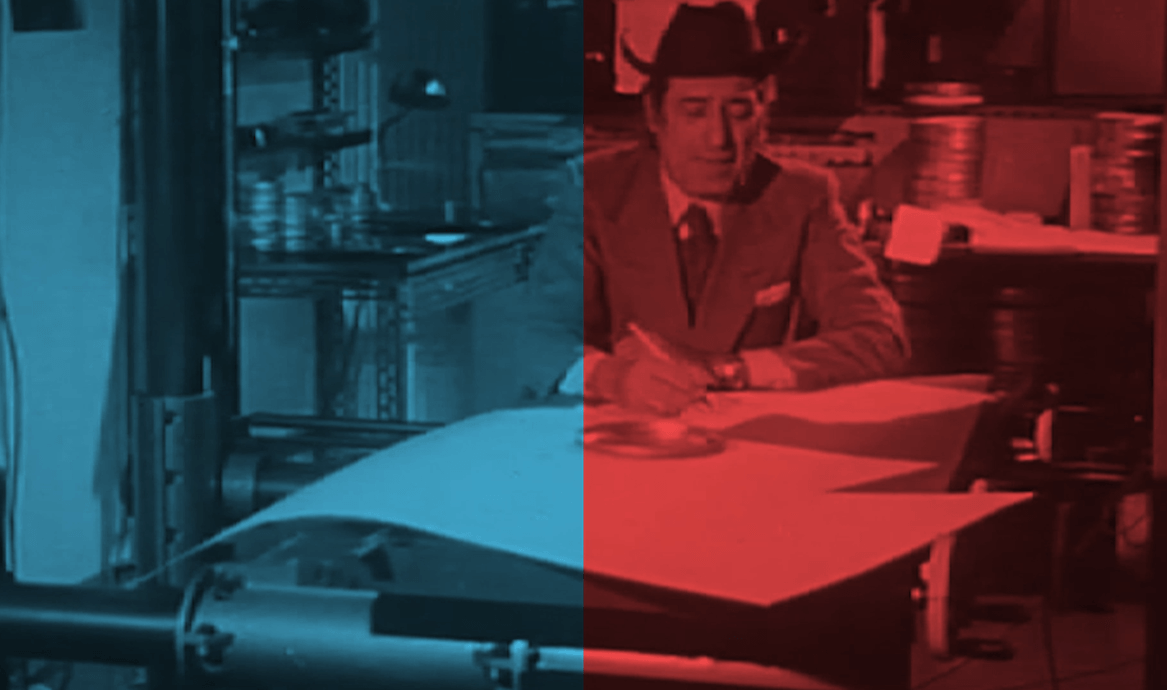
For Armando Testa, curiosity was always the first true step towards creativity.
He approached images without preconceptions: his gaze was driven by a constant hunger for forms, colours and signs.
This unique and distinctive way of looking at the world was modern fifty years ago; today, it feels more contemporary than ever. For us, it has become a school of thought.
Amaze the eye, surprise the heart, delight the mind.”
Synthesis is wonderfully powerful.
The key lesson Armando Testa passed on to us is the constant pursuit of synthesis. The desire to communicate through elemental signs: simple, but never ordinary. The aspiration to “Be essential, in both form and sign.”
Because an image distilled to its essence is powerful and democratic: it reaches everyone. And above all, it never grows old, becoming a gift to those who see it.
This was true in the days of Carosello, and it is even more true today, in the age of social media, scrolling and mobile-first.
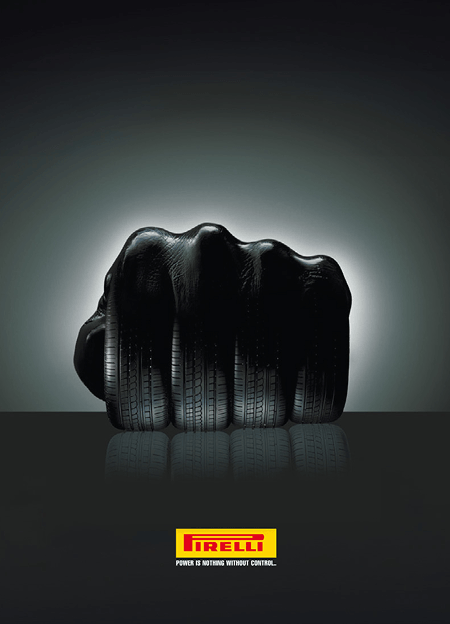
To simplify is to capture the essence of things.
For the Testa school of thought, simplicity transcends time.
Simplifying is a sign of intelligence, because it means capturing the essence of things and transforming it into an idea that remains forever contemporary.
Especially today, as digital communication becomes ever faster, simplicity is perhaps the most modern lesson we have inherited.
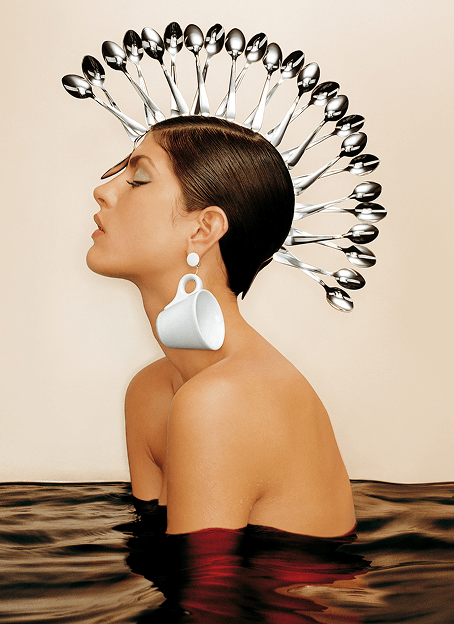
On the viewer’s side.
Even today, we know exactly which side we are on: the viewer’s.
Seeking expressive impact means embracing the dialogue between signs, the ambiguity of images and the visual paradox.
And what we now call the “wow effect” still comes from deep visual research and from words that consistently challenge conventional thinking.

Speaking to everyone through the power of ideas.
I remember my father as a multifaceted innovator: a successful advertising creative, an experimental artist and an interpreter of a highly original vision of design. His creativity was remarkably fluid and open to the many dimensions of visual language, as well as to life and emotion.
The result was a body of work in which art and everyday life are deeply interconnected, driven by synthesis, simplicity and, at the same time, originality.
The evolution from the talent of an individual artist to the emergence of a true Testa school of communication felt entirely natural to all of us. It was an extraordinary human and professional journey.
What excites me most is seeing that distinctive Testa approach to creative challenges remain unchanged to this day. Everything around us has changed: contexts, languages, professions and technologies, products and consumers.
And yet that multifaceted approach — what we might now call integrated — rooted in pure creativity, in a synthesis that is simple but never ordinary, and always close to people’s hearts and minds, has not changed in the slightest.
And I am certain that, as long as this spirit remains part of the way we see the world, we will continue to grow and innovate, speaking to everyone through the power of ideas. In other words, we will keep taking the viewer’s side — as Armando would have said.
marco testa
Armando Testa’s Biography
Taken from the Cucù-Tetè catalogue – edited by Gemma De Angelis Testa
After the war, during which he served as an aerial photographer, he returned to Turin and resumed his work as a graphic designer. He opened a small studio and began working for major companies such as Martini & Rossi, Carpano, Borsalino, and Pirelli. In 1956, Studio Testa was founded—an advertising agency specializing not only in graphic design but also in television. Recognizing the potential of this new medium, Testa established a small production company alongside the agency, where he also experimented with cutting-edge cinematic techniques in the field of animation. Between the 1950s and 1960s, he thus created characters and campaigns that became true icons of the collective imagination: from Caballero & Carmencita for Paulista coffee to the sphere suspended above a half-sphere for Punt e Mes, from Pippo—the blue hippopotamus for Lines diapers—to Mimmo Craig for Sasso oil, and finally Solvi Stubing for Peroni beer.
In 1958, he won the competition for the official poster of the 1960 Rome Olympics.
The design was initially rejected, but in the second round of the competition the following year, Testa emerged as the winner once again. In 1965, he was invited to hold the chair of Drawing and Print Composition at the Polytechnic University of Turin, where he taught until 1971. In 1968, he received the Gold Medal from the Ministry of Education for his contribution to the visual arts, while in 1975 the Italian Advertising Federation awarded him the Gold Medal for his achievements abroad.
In 1978, Studio Testa became Armando Testa S.p.A., with offices abroad as well; it remains one of Italy’s leading advertising agencies to this day.
Starting in the 1980s, Testa devoted himself more to painting and stepped up his work designing posters and logos for cultural institutions and social initiatives. Among his best-known works from this period are those for Amnesty International, the Festival dei Due Mondi in Spoleto, the Teatro Regio in Turin, Expo Arte, the Turin Book Fair, and the Castello di Rivoli Museum of Contemporary Art. In 1989, he received an honorary doctorate from Colorado State University in Fort Collins. He died in Turin on March 20, 1992.
In addition to the numerous exhibitions dedicated to him by Italian and international museums and institutions, his works have been acquired by major museum collections, including the MoMA in New York, the Stedelijk Museum in Amsterdam, the Musée des Arts Décoratifs in Paris, the Ca’ Pesaro International Gallery of Modern Art in Venice (as part of the donation by Gemma De Angelis Testa), the Salce Collection in Treviso, the CSAC in Parma, the “Achille Bertarelli” Civic Print Collection in Milan, the Israel Museum in Jerusalem, the Poster Museum in Warsaw, the Olympic Museum in Lausanne, and the collection of the Victoria and Albert Museum in London.
Creativity is a wonderful thing.